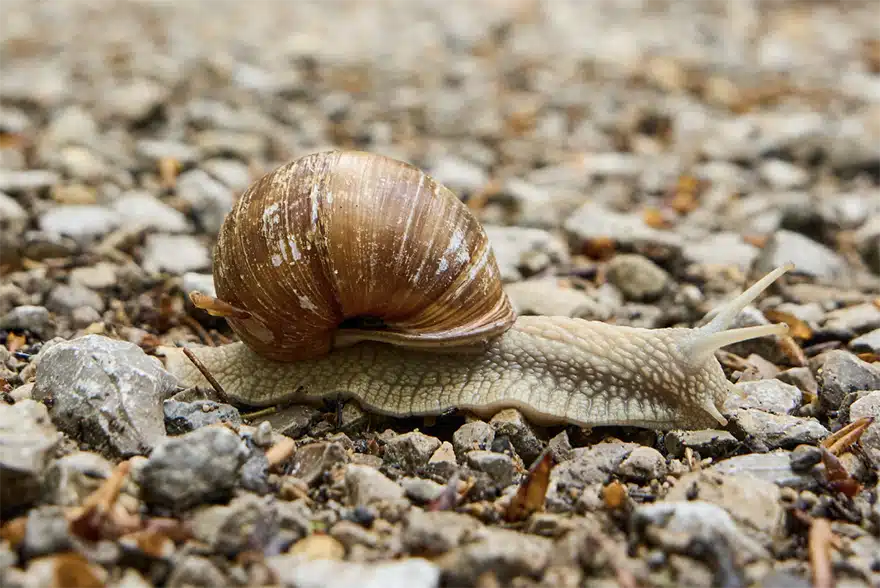
Life cycle of a Land Snail
The life cycle of any animal is the period involving the succession of one generation to the next through reproduction.
In brief, the snail life cycle has the following steps:
1. Born and develop.
2. Reach sexual maturity.
3. Find a partner to mate.
4. Mating process.
5. Gestation period.
6. Egg dropping.
7. Egg hatching.
The age of sexual maturity is variable from 6 weeks to 5 years, depending on species of snail. The breeding process of snails has some unique features when compared to other land animals.
Reproduction of land snails is carried out under odd circumstances. First, most of these gastropod mollusks are hermaphrodites so that a single snail may have male and female reproductive organs. Second, on most occasions, two individuals copulate rather than self-fertilize. And third, they have the habit of shooting some structures called “love darts” just before mating.
Mating and beyond
Land snails engage in various types of courting rituals to attract mates. They can last breeding from a couple of hours to half a day.
They don’t make sounds to lure each other like many types of animals do because snails don’t have the ability to hear. So they expel some chemicals to attract others ready to mate and use touching as a way of courting. Once the mating is over, they go in separate directions.
Snails will produce around 100 eggs, but some species can have up to 400.
Snail breeding involves sexual reproduction. During copulation, both individuals can transfer sperm to each other, but it does not happen in all cases. The sperm is transferred using a penis or spermatophore exiting the body during the intercourse. Then, the sperm enters the body of the other snail to fertilize the eggs later.
Even though snails are hermaphrodites, they mate in the traditional way, they do not fertilize themselves. However, after the mating, both snails can deliver a set of eggs which increases the chances of survival.
When fertilization occurs, eggs develop. Laying the eggs happens in the following days, but the time varies according to the species. As they are promiscuous animals, they can store sperm from previous couples for a long time, even years.
After the mating process, both snails will produce around 100 eggs, but some species can have up to 400. These eggs are tiny, and they will be dropped into moist soil and covered. It can take up to four weeks for them to hatch.
Before laying their eggs, some snails build a nest in a hole, between vegetation or on the ground. If it is in the soil, the animal digs with the aid of its ventral foot until obtaining a hole with a depth of 2 to 4 inches. Once the snail has the proper place, it puts the 100 small and round eggs, often white, surrounded by a viscous layer that serves as protection. They usually have a diameter between 3 and 6 millimeters.
Even with so many eggs produced, only a fraction of these snails reach maturity. Many of the eggs are washed away by rain or water or eaten by predators, despite the outer protective layer and being resistant to cold and heat. Even humans take them, which are known as white caviar or snail caviar, consumed in some regions of the world.
Land snails can lay eggs once a month.
From breeding to adulthood.
The shell of the snail develops since it is an embryo inside its egg. Under favorable conditions, eggs hatch after approximately two weeks to 1 month and snails emerge with a soft shell. Therefore, they need to feed themselves to get calcium, and the first source to get it is by consuming the remains of their egg and even other eggs that have not yet hatched.
Shells continue to grow with the snail over the course of its life.
The baby snails have, in addition to a soft shell, an almost transparent body that acquires strength and color as it grows. The first color they usually have is bluish but then turns to brown or the color that characterizes their species. They grow remarkably fast, but very few reach one year of age. In general, snails are victims of numerous predators, and young individuals are even more vulnerable because of their incomplete development.
Shells continue to grow with the snail over the course of its life, and the rings it has are indicators of their age.
The whole life cycle of a land snail is not very long in human terms. A single snail can live 2 to 7 years according to its species, but in captivity, the life expectancy extends to 10 or 15. In few occasions, they live longer.
Stopping and hibernating
Some land snails enter a period of lethargy in which they decrease their metabolic rate, and both respiration and heart rate become slower than usual. If it happens in summer is called estivation, but if it occurs in winter, it is hibernation. During this process, to keep their moisture and protect from predators, snails retract into their shell and secrete a layer of mucus called epiphragm, which closes the opening.
Some young snails show a tendency to remain near the place where their eggs hatched, and if they go away, return there in the mornings.
Sources:
http://scienceline.ucsb.edu/getkey.php?key=2578
Animals, a visual encyclopedia. Second edition. Smithsonian 2012.
http://www.molluscs.at/gastropoda/index.html?/gastropoda/morphology/reproduction.html
http://news.nationalgeographic.com/2015/03/150310-snails-reproduction-sex-animals-science-evolution/
BioExpedition Publishing © 2017.